INDmoney US stocks charges go beyond the brokerage shown when you place an order. Currency conversion, GST and applicable transaction fees can affect how much money you invest and eventually receive in your Indian bank account.
Use my INDmoney code DEE60MQPIND to join INDmoney and check the referral benefits available to you during signup.
The first detail to check is your account route. INDmoney’s pricing page lists separate schedules for Global Access and Direct Access (NSEIX). Global Access lists 0.25% brokerage per transaction, capped at $25 excluding GST. Direct Access lists zero brokerage.
These schedules should not be treated as interchangeable.
When comparing an investment platform, I prefer to follow the complete movement of money: how much leaves the bank, how much gets invested, and how much comes back after selling. That gives a clearer picture than looking only at a “free account” or “zero withdrawal fee” headline.
This guide explains the charges, includes a worked example and highlights the details worth checking before you fund your account.
Dhan App Review – Brokerage Charges, Referral Code: DHAN30, Safety, Download & Honest Experience: INDmoney US Stocks Charges: Brokerage, Forex & WithdrawalINDmoney US Stocks Charges at a Glance
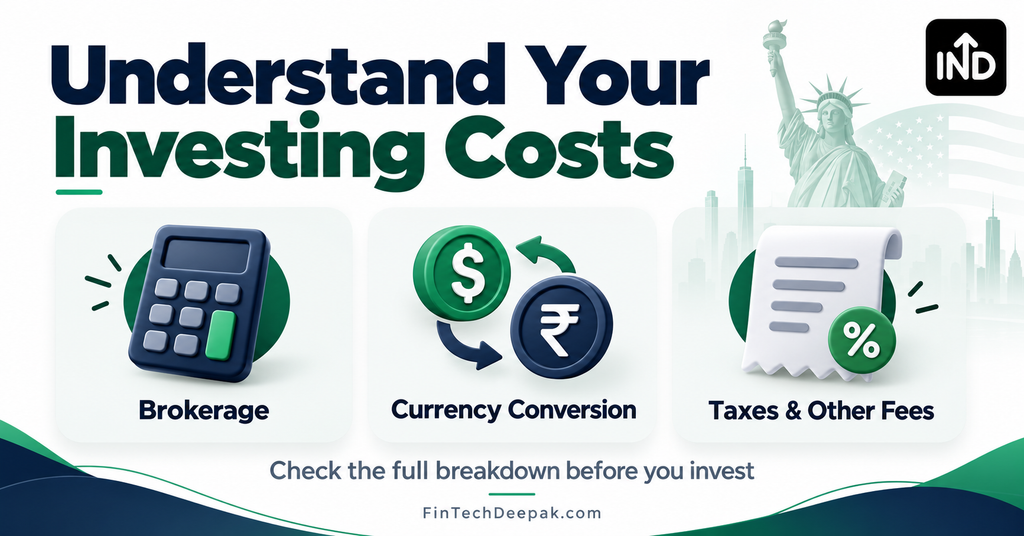
The following table summarises the headline charges published for INDmoney’s US-stock offering. The brokerage shown here relates to Global Access.
| Cost category | Published charge |
|---|---|
| Account opening | Zero |
| Annual maintenance | Zero |
| Platform deposit fee | Zero |
| Platform withdrawal fee | Zero |
| Taxation and transaction reports | Zero |
| Global Access brokerage | 0.25% per transaction, capped at $25 excluding GST |
| Bank forex conversion charges | Published range of 0.5%–1.2%; actual quote varies |
| Other transaction charges | Depend on the applicable route and transaction |
Zero account-opening and maintenance fees are useful, but they do not make every investment transaction free.
Someone making occasional purchases and holding them will have a different cost pattern from someone frequently buying, selling and converting dollars back into rupees.
INDmoney US Stocks Charges by Account Route
INDmoney’s pricing page displays a Global Access schedule effective from 1 August 2026 and a separate Direct Access schedule.
| Pricing route | Published brokerage |
|---|---|
| Global Access | 0.25% per transaction, maximum $25 excluding GST |
| Direct Access (NSEIX) | Zero brokerage |
The existence of a zero-brokerage schedule does not mean every account or investment automatically qualifies for it.
Before calculating INDmoney US stocks charges:
- Check the account or product description in your app.
- Open the pricing schedule applicable to that account.
- Review the charge breakdown before confirming an order.
- Compare the estimate with your completed transaction statement.
If the route is unclear, ask support which pricing schedule applies to your account.
This is particularly useful when an older article, a promotional message and your order preview show different figures.
INDmoney Brokerage Charges for US Stocks
For Global Access, the published brokerage calculation is:
Trade value × 0.25%, subject to a maximum of $25 per transaction, excluding GST.
Here are some examples:
| Trade value | Brokerage before GST |
|---|---|
| $100 | $0.25 |
| $500 | $1.25 |
| $1,000 | $2.50 |
| $5,000 | $12.50 |
| $10,000 | $25 |
| $20,000 | $25, applying the cap |
Buying and selling are separate transactions.
If you buy $1,000 worth of shares and later sell them for $1,000, the calculated brokerage is $2.50 on each side. That is $5 combined before GST and other applicable charges.
When estimating INDmoney US stocks charges, include both transactions rather than looking only at the purchase.
How GST Affects INDmoney US Stocks Charges
Using 18% GST on brokerage, a $1,000 transaction produces the following calculation:
| Component | Amount |
|---|---|
| Brokerage at 0.25% | $2.50 |
| GST at 18% of brokerage | $0.45 |
| Brokerage including GST | $2.95 |
The tax in this example applies to the brokerage amount, not to the entire $1,000 share purchase.
For your actual order, check the tax breakdown displayed in the app. Other fees may have different treatment, including rates already stated as tax-inclusive.
Forex Conversion Is a Separate Cost
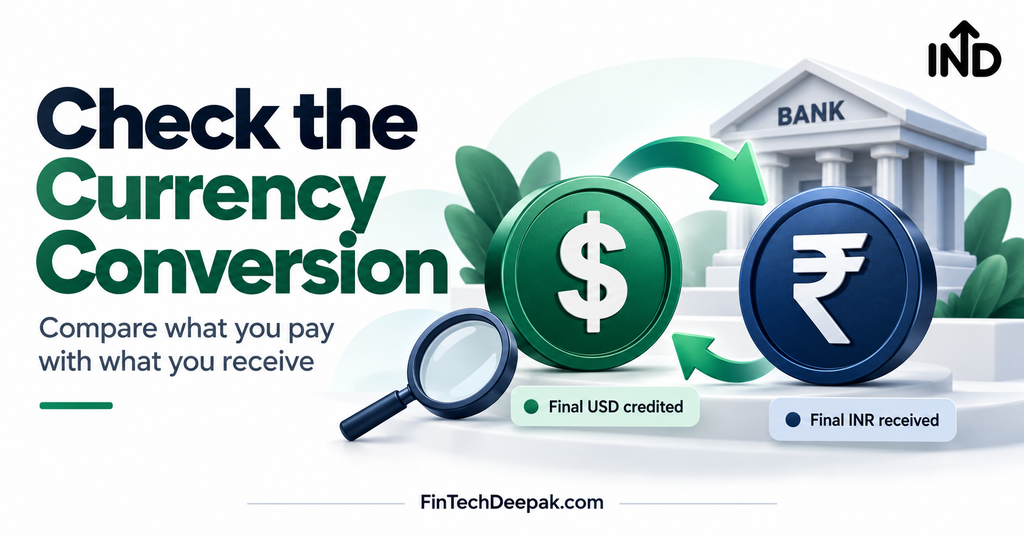
Forex conversion is an important part of INDmoney US stocks charges because your rupees need to become dollars before you invest.
INDmoney publishes a bank conversion-charge range of 0.5%–1.2%. The actual quote can vary with the bank, transaction amount, route and timing.
My preferred comparison is simple:
How many dollars will I receive for the total amount debited from my bank?
Consider these hypothetical quotes:
| Item | Quote A | Quote B |
|---|---|---|
| Total rupees debited | ₹50,000 | ₹50,000 |
| Final dollars credited | $590 | $585 |
| Effective rupees paid per dollar | ₹84.75 | ₹85.47 |
These are illustrative figures, not current exchange rates.
Quote A provides $5 more for the same bank debit. That difference matters even if both transfer screens show zero platform deposit fees.
You can calculate the effective funding rate yourself:
Effective funding rate = Total INR debited ÷ Final USD credited
Compare quotes taken at approximately the same time. Otherwise, market exchange-rate movement can make the comparison misleading.
Also check whether any tax or bank fee is included in the quote or debited separately.
INDmoney US Stocks Withdrawal Charges
INDmoney advertises zero platform withdrawal fees for its US-stock offering.
However, a zero withdrawal fee does not automatically mean that converting your dollars back into rupees has no cost. The exchange-rate quote and any applicable bank deductions still matter.
Before confirming a withdrawal, check:
- The USD amount you are withdrawing.
- The quoted USD-to-INR conversion rate.
- Any separately displayed fees or deductions.
- The estimated final amount reaching your bank.
For example, withdrawing $500 at a hypothetical quoted rate of ₹83 per dollar would produce ₹41,500 before any separately disclosed deductions.
The number I would compare is the final bank credit.
Exchange-Rate Movement Is Different From a Fee
Suppose the rupee strengthens between your investment and withdrawal. Your dollars may convert into fewer rupees even if the platform has not increased its charges.
That is currency movement, not necessarily an extra fee.
To understand the outcome properly, separate:
- The investment’s gain or loss in dollars.
- Changes in the market exchange rate.
- Currency-conversion costs.
- Brokerage, taxes and other transaction charges.
Combining everything under “withdrawal charges” makes it difficult to identify what actually happened.
INDmoney US Stocks Charges: A Worked Example
Let us follow a hypothetical investment from deposit to withdrawal.
Assumptions Used
- Starting amount: ₹50,000.
- Reference exchange rate: ₹85 per dollar, unchanged throughout.
- Illustrative conversion cost: 1% deducted on entry and exit.
- Global Access brokerage: 0.25% on the purchase and sale.
- GST: 18% on brokerage.
- The investment’s dollar price remains unchanged.
- Purchase brokerage and GST are funded from the available wallet balance.
The assumed 1% deductions simplify the example. Your bank may incorporate conversion costs into its exchange rate instead of displaying a separate percentage deduction.
| Step | Illustrative calculation | Result |
|---|---|---|
| Starting amount | Initial bank funding | ₹50,000 |
| Entry conversion cost | Deduct assumed 1% | ₹49,500 remains |
| Dollars credited | ₹49,500 ÷ ₹85 | $582.35 |
| Amount invested | Reserve purchase brokerage and GST within the wallet balance | About $580.64 |
| Purchase brokerage and GST | Approximately 0.295% of the purchase value | About $1.71 |
| Sale value | Investment price remains unchanged | About $580.64 |
| Sale brokerage and GST | Approximately 0.295% of the sale value | About $1.71 |
| Dollars remaining | Sale proceeds after those charges | About $578.93 |
| Conversion before exit cost | Remaining dollars × ₹85 | About ₹49,208.81 |
| Final INR received | Deduct assumed 1% exit conversion cost | About ₹48,716.72 |
Under these assumptions, the difference from the original ₹50,000 is approximately ₹1,283.28, or 2.57%.
The calculations use unrounded intermediate figures, so multiplying the rounded table entries may produce a small difference.
This is not an all-inclusive fee quote. It excludes regulatory charges, separate bank fees or forex-related taxes, investment taxes and other applicable costs.
The practical lesson is that an unchanged stock price does not necessarily mean you get your original rupee amount back.
Additional INDmoney US Stocks Charges to Check
Brokerage and forex conversion are the main costs many readers notice, but they are not the only entries worth reviewing.
Regulatory and Turnover Fees
The Global Access pricing schedule lists SEC and TAF charges on sell orders and an IFSCA turnover fee.
Check the current rates, minimums and applicability in your transaction preview. These entries should be included when calculating the complete cost of a trade.
Low-Price Share Fee
The pricing schedule also lists a DriveWealth-specific low-price fee for shares priced below $1.
A low share price does not automatically make a transaction inexpensive. Check whether additional charges apply before buying such securities.
ETF Expenses
If you invest in an ETF, review its expense ratio and other fund disclosures.
The investment’s ongoing expenses are separate from the platform’s charges for buying or selling it.
Taxes and Remittance Requirements
GST, potentially applicable TCS, and taxes on investment income are different matters.
Do not treat every tax-related debit as a platform fee, and do not assume that a zero-fee account removes your reporting obligations. The applicable treatment depends on current rules and your circumstances.
How to Compare INDmoney US Stocks Charges
I would compare platforms using the same funding amount and investment pattern.
For a ₹50,000 investment, the questions would be:
| Stage | What I would compare |
|---|---|
| Funding | Final USD received for the same total INR debit |
| Purchase | Brokerage, GST and other order charges |
| Holding | Account fees and investment expenses |
| Sale | Brokerage and applicable sell-side charges |
| Withdrawal | Final INR received after conversion and deductions |
This approach makes INDmoney US stocks charges easier to compare with another platform’s pricing.
One detail often missed is that fewer orders do not always mean lower percentage-based brokerage.
At a purely proportional rate, ten $100 purchases and one $1,000 purchase produce the same base brokerage. Differences arise from minimum charges, rounding, caps or other fees.
Similarly, repeated currency conversion can add costs. Before moving money between INR and USD, check the quote and consider your actual cash requirements.
For another explanation of currency-related fees, read my OneCard forex charges guide. Credit-card purchases and investment remittances have different rules, but separating the exchange rate from additional fees is useful in both cases.
INDmoney Referral Code: DEE60MQPIND

If you decide INDmoney suits your investing needs, you can use my referral code DEE60MQPIND when signing up.
| Referral detail | Information |
|---|---|
| Referral code | DEE60MQPIND |
| Joining link | Join INDmoney using my referral link |
Open the link and follow the registration process. If a referral-code field appears, enter DEE60MQPIND.
Check the offer and eligibility conditions displayed during signup. Any joining benefit should be confirmed from the offer available to your account.
Review INDmoney US stocks charges before funding your account. A referral benefit can be useful, but ongoing transaction costs matter beyond registration.
Referral disclosure: I may receive a benefit if you join through my link or code and fulfil the applicable conditions. Any benefit for you depends on INDmoney’s offer. Investment returns are not guaranteed.
Conclusion: Understanding INDmoney US Stocks Charges
The most useful way to evaluate INDmoney US stocks charges is to follow the complete transaction: deposit, currency conversion, purchase, sale and withdrawal.
Start by confirming your account route. Then compare the dollars credited, the order-level charges and the final INR withdrawal quote.
Keep a record of those figures so you can reconcile the completed transaction. That gives you a much clearer understanding of the cost than relying on a single advertised percentage.
FAQs
What are INDmoney US stocks charges?
They depend on your account route and transaction. Relevant costs can include brokerage, GST, regulatory fees and bank currency-conversion charges.
Is INDmoney US-stock investing brokerage-free?
INDmoney’s pricing page lists zero brokerage for Direct Access (NSEIX). Global Access has a separate schedule listing 0.25% brokerage per transaction, capped at $25 excluding GST.
Confirm which schedule applies to your account.
Does INDmoney charge brokerage when selling US stocks?
Under the Global Access schedule discussed here, brokerage applies to purchases and sales. Sell-side regulatory charges may also apply.
How much is brokerage on a $1,000 transaction?
At 0.25%, brokerage is $2.50. With 18% GST on that brokerage, the combined amount is $2.95 before other applicable charges.
Does zero withdrawal fee mean currency conversion is free?
No. A platform withdrawal fee and a bank’s currency-conversion quote are separate components. Check the final INR amount before confirming.
Can I receive less money even if the stock price does not change?
Yes. Trading costs, currency-conversion costs and exchange-rate movement can affect the amount returned to your bank.
Does the worked example show my exact charges?
No. It uses clearly stated assumptions to explain the calculation. Your actual costs depend on the applicable pricing schedule, bank quote, transaction and taxes.
What is the INDmoney referral code?
My referral code is DEE60MQPIND. You can use the INDmoney joining link and check the applicable offer during registration.