
Called a fake customer care number while trying to resolve a refund, failed payment or delivery issue? Your next step depends on what happened during the conversation: whether you only spoke, shared sensitive information, installed an app or transferred money.
End the conversation and stop following the person’s instructions. If money has been taken, contact your bank through a verified channel immediately, call 1930 and report the incident at cybercrime.gov.in.
Calling a suspicious number does not, by itself, establish that someone has accessed your bank account. However, sharing credentials, approving payments or allowing remote access requires prompt action.
This guide draws on official Indian fraud-awareness and reporting resources. It is not a personal account of being scammed, and no reporting process guarantees recovery.
Called a Fake Customer Care Number? Start Here
Before doing anything else, identify what you shared or approved.
| What happened | What to do next |
|---|---|
| You only spoke to the person | End contact, preserve the number and watch for follow-up attempts. |
| You shared your name, phone number or order details | Be alert to convincing follow-up messages and verify support independently. |
| You shared an OTP or password | Secure the account connected to that code or password immediately. |
| You shared card details or a banking PIN | Contact the bank through an official channel and request appropriate blocking or restrictions. |
| You installed an app or allowed screen sharing | Disconnect the session, isolate the affected device and use a trusted device to secure accounts. |
| You approved a payment or money was deducted | Contact your bank promptly, call 1930 and submit a cybercrime complaint. |
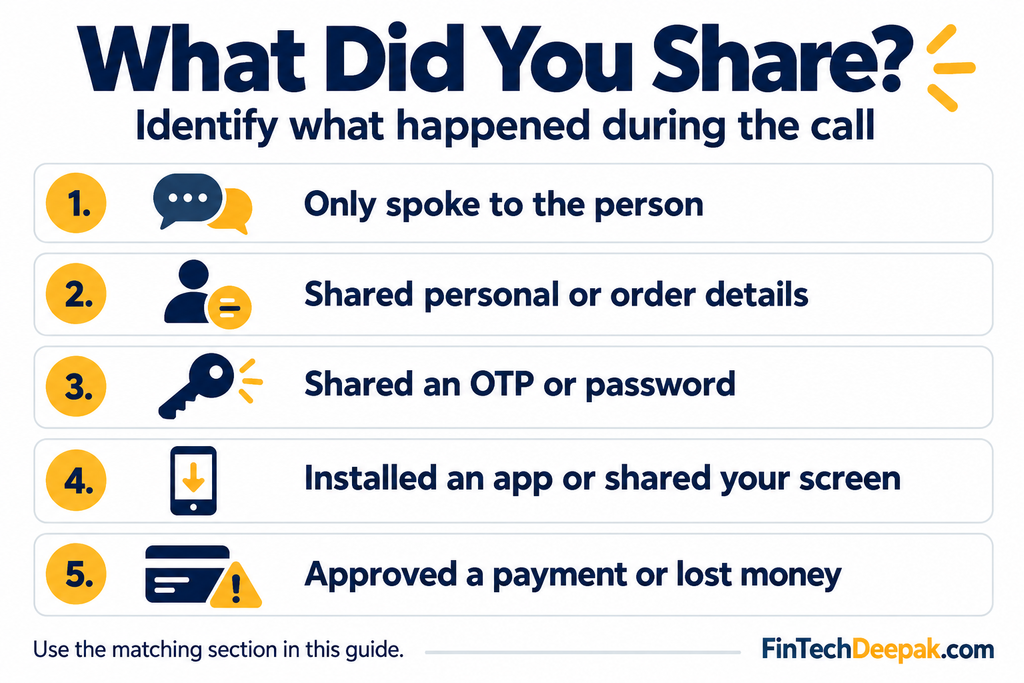
If several situations apply, prioritise stopping ongoing access and reporting any financial loss.
1. Called a Fake Customer Care Number but Shared Nothing?
If you called a fake customer care number but did not share sensitive information, open links, install anything or approve a transaction, avoid assuming that your phone has automatically been hacked.
Take these precautions:
- Save the number and the time of the call.
- Preserve the webpage or message where you found it.
- Block the number after saving relevant evidence.
- Check for unexpected login or transaction alerts.
- Continue your original complaint through the company’s official support channel.
A follow-up caller may refer to your earlier conversation to sound legitimate. Knowing your complaint does not prove that the caller works for the company.
The practical distinction is between having a conversation and giving someone access or payment authorisation. Think through what actually happened before deciding which accounts need protection.
2. If You Shared Your Name, Phone Number or Order Details
These details are different from a password or banking PIN, but they can help someone make the next scam attempt more convincing.
For example, a person might contact you again and mention the correct order value, product or refund amount. Treat that familiarity as information they possess—not proof of identity.
If you called a fake customer care number and shared order details:
- Contact the real company through its app or independently verified website.
- Tell support what information was disclosed.
- Review your account for unfamiliar changes.
- Avoid links claiming that a refund is waiting for “verification.”
- Do not post screenshots containing your address, phone number or order information publicly.
If you also disclosed an account password, move immediately to the next section.
3. Called a Fake Customer Care Number and Shared an OTP?
An OTP is not always a banking OTP. It could authorise an account login, password reset, device registration or payment.
Read the original message to identify what the code was intended to approve. Do not share another code with the caller to “cancel” the first one.
From a trusted device:
- Open the affected service independently.
- Change the compromised password.
- Sign out unfamiliar sessions where the service allows it.
- Check recovery email addresses and phone numbers.
- Enable additional account protection where available.
- Contact official support if you cannot regain access.
If you reused the same password elsewhere, change it on those accounts too.
For banking credentials, card details or transaction authorisation codes, contact the bank immediately. Explain precisely what was shared so it can advise on blocking the card, restricting access or other protective steps.
The Reserve Bank of India’s fraud-awareness advisory describes fake support numbers and remote-access applications among methods used to deceive customers.
4. Called a Fake Customer Care Number and Installed an App?
This needs particular attention because the person may have seen information on your screen or obtained remote-control permissions.
If you called a fake customer care number and followed instructions to install an unfamiliar app:
- End the screen-sharing or remote-access session.
- Disconnect the affected device from Wi-Fi and mobile data.
- Use another trusted device or phone to contact your bank and secure affected accounts.
- Record the app’s name and preserve relevant messages where possible.
- Remove the suspicious app and review permissions it was granted.
- Seek trusted technical assistance if access persists or you cannot remove the app.
Do not open banking apps or type new passwords while a suspicious remote session is active.
Removing an app does not undo information already exposed or transactions already authorised. Account protection and financial reporting may still be necessary.
5. Called a Fake Customer Care Number and Lost Money?
Act promptly. Do not wait for the supposed executive to process a reversal.
Contact your bank through a verified channel
Use the bank’s official app, the number printed on your card or statement, or its independently verified website.
Explain:
- When the incident happened.
- How much money was involved.
- Which account, card or payment service was used.
- Whether you shared credentials or authorised a payment.
- Whether remote access was involved.
Request a complaint reference number and record the bank’s instructions. Describe events accurately, including payments you approved after being misled.
Call 1930 and report the incident online
For financial cybercrime in India, call 1930 and submit the incident at the National Cyber Crime Reporting Portal.
Keep acknowledgement numbers and follow the instructions provided. Reporting to the bank and reporting to cybercrime authorities are separate actions; do not assume one automatically completes the other.
Preserve the evidence
Keep copies of:
- Transaction IDs, amounts, dates and times.
- Recipient UPI IDs or bank details, if available.
- Call logs and phone numbers.
- Messages, emails and relevant URLs.
- Screenshots of the listing or advertisement.
- Bank and cybercrime complaint acknowledgements.
Do not delay urgent reporting while trying to assemble a perfect evidence folder. Provide the information available and retain additional records.
Where Should You Report the Number?
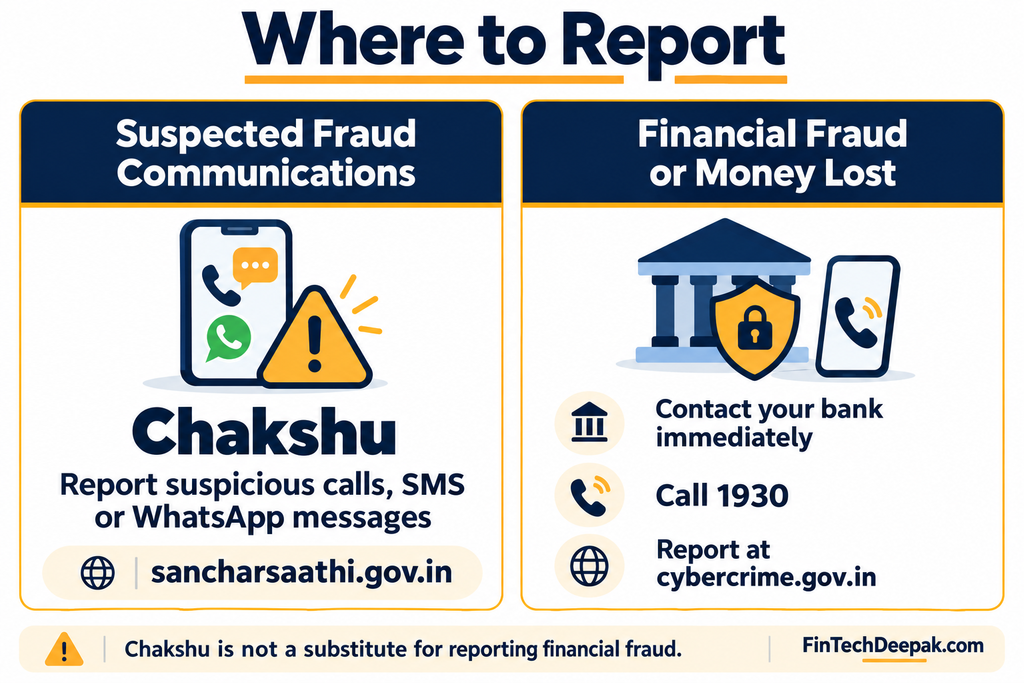
If you called a fake customer care number, distinguish a suspicious communication from an incident involving financial loss.
| Situation | Relevant route |
|---|---|
| Suspicious calls, messages or WhatsApp communications attempting fraud | Check the reporting options on Sanchar Saathi’s Chakshu facility. |
| Financial cybercrime or money lost | Contact your bank, call 1930 and report at cybercrime.gov.in. |
| The original delivery, refund or service complaint | Continue separately through the company’s official support process. |
Chakshu is not a substitute for reporting financial fraud. The Government of India’s explanation of Chakshu directs people who are already victims of cybercrime or financial fraud to 1930 or the cybercrime portal.
What Most People Miss About Refund Scams
A correct complaint detail does not authenticate the caller
Someone who knows your order number or refund amount may simply be using information you shared earlier.
Receiving a refund does not require approving an outgoing UPI payment
NPCI’s fraud-awareness guidance explains that scanning a QR code and entering a UPI PIN is for making payments, not receiving money.
Read the payment screen itself. The caller’s description of the transaction is not a substitute for checking what you are authorising.
A failed payment and a fraudulent payment are different problems
A delayed withdrawal may need normal support; a payment made to an impersonator requires a fraud response.
For example, readers investigating a legitimate broker payout can consult our Dhan withdrawal time guide. Do not apply ordinary processing timelines to a suspected scam.
A second caller cannot guarantee recovery
Be cautious if someone contacts you promising to recover the money for an upfront fee. Verify any claimed connection to your bank or authorities independently.
How to Find Genuine Customer Support Next Time
Start inside the service’s official app, especially its Help, Support or Contact section.
If using a website, verify the domain independently. Avoid treating a search advertisement, comment, directory entry or familiar-looking logo as sufficient verification.
Some services offer chat or callback support rather than a publicly listed telephone helpline. Follow the options actually provided by the company.
The useful habit is simple: verify the source of the number before explaining your problem or following instructions.
Conclusion
If you called a fake customer care number, focus on what you shared and what access you allowed. A conversation alone is different from disclosing credentials, installing remote-access software or approving a payment.
End contact, protect affected accounts and preserve evidence. If money was lost, contact your bank promptly, call 1930 and report through cybercrime.gov.in. Avoid anyone promising guaranteed recovery.
Frequently Asked Questions
Can my bank account be accessed if I only called a fake customer care number?
A call alone does not establish that your bank account was accessed. The concern increases if you shared credentials, approved a payment, installed software or allowed access. Review what happened and check for unfamiliar activity.
What if I called a fake customer care number and shared only my order details?
Those details alone do not establish banking access. Watch for targeted follow-up attempts and contact the real company. If you also shared financial credentials or notice unauthorised activity, contact your bank promptly.
What if I shared an OTP but no money has been deducted?
Do not wait for a deduction. Identify which service issued the OTP and secure that account. Contact your bank immediately if the code related to banking or payments.
Is deleting the remote-access app enough?
Not necessarily. Information may already have been exposed. Secure affected accounts from a trusted device, review transactions and contact your bank if financial information was involved.
Should I use Chakshu if I lost money?
Chakshu handles suspected fraudulent communications. For financial cybercrime, contact your bank, call 1930 and report at cybercrime.gov.in.
Can I recover money after I called a fake customer care number?
Recovery may be possible, but it is not guaranteed. Contact your bank and report the fraud promptly through 1930 and cybercrime.gov.in. The outcome depends on the circumstances and action taken by the relevant institutions and authorities.